Cart
0
You may also like







There is a moment many parents don’t forget.
Your child hasn’t eaten dinner.
They haven’t eaten much all day.
You offer something new - again - and they calmly say no.
Not a tantrum. Not drama. Just… no.
So you do what love does when theory fails. You make the peanut butter sandwich. You shave carrots into it. You give the multivitamin. You promise yourself you’ll do better tomorrow.
And somewhere between worry and guilt, a quiet fear settles in:
What if my child never learns to eat properly?
Here’s the reframe that changes everything:
Most picky eating problems are not created at age three. They are revealed at age three.
They are often rooted much earlier, during the months when the palate, the gut, and the brain were learning what “food” feels like.
Between around six months and two years of age, a child’s body is doing something extraordinary. Taste receptors are highly sensitive. Neural pathways between the mouth, gut, and brain are rapidly forming. Digestive enzymes are learning what kinds of foods they will need to process in the future.
This is not just about liking or disliking food.
This is biological training.
Research in early childhood nutrition consistently shows that repeated exposure to a wide range of flavours and textures early in life is associated with greater food acceptance later. The American Academy of Paediatrics notes that flavour exposure during complementary feeding influences taste preferences well into childhood. The World Health Organization highlights dietary diversity in infancy as a foundation for long-term nutritional adequacy.
In simple terms:
The palate doesn’t decide.
It learns.
When a child is exposed early to grains, pulses, nuts, seeds, vegetables, and natural fats — in age-appropriate, well-prepared forms - their digestive system learns how to handle complexity. Their nervous system learns that variety is safe.
This is why traditional weaning foods across cultures were rarely single ingredients. They were thoughtful blends: grain with pulse, seed with fat, vegetable with carbohydrate. Not because ancient parents were trying to be clever - but because the body digests balance better than extremes.
A child introduced early to this diversity often grows into a more comfortable eater.
Not adventurous. Not perfect.
Just comfortable.
And comfort is everything.
When early feeding is narrow - same flavours, same textures, same nutrient profiles — nothing has “gone wrong.” The palate simply hasn’t been trained for variety.
Fast forward to toddlerhood.
Growth slows, so appetite naturally drops. Autonomy rises, so “no” becomes powerful. Sensory sensitivity peaks. Anxiety around unpredictability increases. And digestion, while stronger than infancy, is still maturing.
Now when something unfamiliar appears, the child’s system doesn’t say, “Interesting.”
It says, “Unknown.”
And unknown feels unsafe.
This is why some children would genuinely rather go hungry than eat something new. Hunger is familiar. Anxiety is not.
This is not stubbornness.
It is self-regulation.
Most feeding advice focuses on behaviour - exposure rules, bite counts, structure.
But from a paediatric nutrition lens, feeding is something deeper.
It is digestive education.
Every time a child eats, three systems are learning simultaneously:
the digestive system learns what enzymes to release,
the gut learns how to absorb nutrients efficiently,
and the brain learns whether food is safe or stressful.
This matters because stress and digestion are biologically opposed. When a child feels watched, rushed, praised, bribed, or pressured, the nervous system shifts into defence mode. Blood flow moves away from the gut. Digestive efficiency drops. Appetite shrinks.
This is why some children technically “eat enough” but still struggle with energy, immunity, or growth. Absorption suffers when safety is missing.
Food quality matters.
But how the body receives food matters just as much.
Also read - Digestion Made Simple: A Parent-Led, Kid-Friendly Guide to How Food Becomes Fuel
Not tricks. Not force. Consistent, practical changes grounded in how children actually develop.
The first shift is to stop chasing variety and start building familiarity through diversity.
This sounds contradictory, but it is one of the most effective strategies we see clinically.
Instead of constantly introducing new foods, parents do better by keeping formats familiar and slowly diversifying what’s inside them. If your child eats porridge, keep the porridge and vary the grains or pulses. If they eat rotis, enrich the dough. If pancakes work, change the base - not the shape.
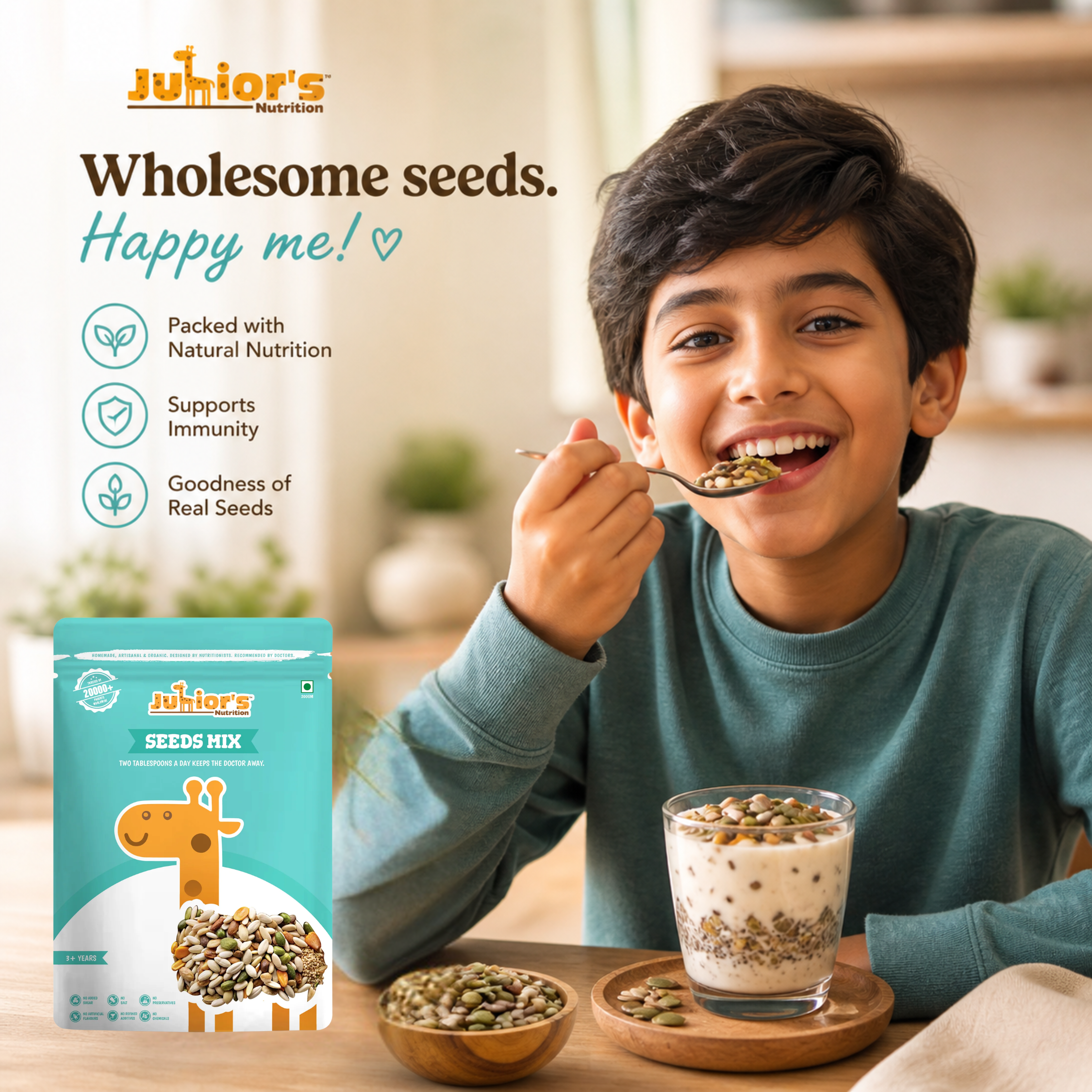
Blends that combine grains, pulses, nuts, and seeds - prepared through roasting or gentle cooking - allow the gut to experience complexity without triggering anxiety. This is how traditional multi-ingredient mixes were historically used: not as “superfoods,” but as digestive teachers.
The child doesn’t experience novelty.
The body experiences nourishment.
The second shift is to prioritise nervous system safety over plate completion.
A calm child digests better than a compliant child.
If every meal feels emotionally loaded - eyes watching, comments counting bites, disappointment when they stop - digestion shuts down. Appetite follows.
Instead, create one predictable anchor at each meal. One food you know your child will eat. Not as a reward. As regulation. When the nervous system feels safe, curiosity returns on its own timeline.
This is not permissive feeding.
It is biologically informed feeding.
The third shift is to think in weeks, not meals.
Paediatric nutrition does not work meal to meal. It works cumulatively.
If over the course of a week your child gets consistent protein, adequate fats, enough energy, and baseline micronutrients, they are not “behind” - even if vegetables are limited right now. Growth charts, energy levels, sleep, and development matter more than dinner wins.
This is why supplements, fortified foods, and enriched staples are sometimes appropriate bridges. They support nutrition while the palate and nervous system catch up. There is no shame in this.
The fourth shift is to recognise that appetite follows digestion, not the other way around.
Parents often assume children don’t eat because they aren’t hungry. In reality, many children aren’t hungry because digestion has been disrupted by stress, irregular routines, or excessive snacking on low-nutrient foods.
Regular meal timing, predictable formats, and balanced macronutrients help digestion stabilise - and appetite often improves naturally after that.
The fifth shift is to trust early exposure more than late pressure.
Children who are gently exposed to a wide range of foods from six months onward - especially in blended, balanced forms - tend to show more comfort with food later, even if they go through picky phases.
Pressure delays progress.
Familiarity accelerates it.
Children who feel safe around food grow into adults who trust their bodies.
Children who are forced often learn to disconnect - from hunger, fullness, and eventually from nutrition itself.
When a child’s palate is gently developed from six months onward, through exposure to real, varied, thoughtfully prepared foods, the outcome is not a perfect eater.
It is a child who does not fear food.
And fear, more than anything, is what keeps picky eating alive.
If your three-year-old lives on yogurt, bread, and peanut butter right now, you are not failing.
If you’ve “caved” to keep them fed, you are responding appropriately to a developing nervous system.
If progress feels slow, that’s because biology moves slower than advice.
Food is not just fuel.
It is sensory input.
It is emotional safety.
It is therapy.
And when we feed children with understanding instead of urgency, their bodies learn — quietly, steadily - to open up again.
That is how picky eating resolves.
Not through pressure.
But through patience, preparation, and trust.
Tasneem Sangani is the co-founder of Juniors Nutrition and a passionate advocate for building generational health through mindful, clean-label child nutrition. As a certified Reiki Master, she brings deep insight into how emotional regulation, nervous system safety, and mindful eating intersect with digestive confidence and lifelong food habits.
Driven by the mission to nurture a generation that is physically resilient, emotionally grounded, and energetically balanced, Tasneem stands by one promise:
“If it’s not good enough for my own children, it’s not going anywhere near yours.”
Her work bridges ancient nutritional wisdom with contemporary science, helping families feel confident, calm, and competent at every stage of their child’s feeding journey.


